
Prices of agricultural commodities have risen 23 per cent so far this month.
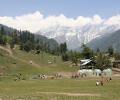
Even as swine flu is threatening the hospitality industry, travellers are taking advantage of the Independence Day holiday to pack their bags for a weekend trip. Most hotels at travel destinations, domestic and international, are packed for the weekend.

This upturn comes soon after an earlier stalling of demand. In February, DLF, the country's largest property developer, said it had stalled construction on 16 million sq ft of commercial space (retail and office) due to lack of demand. So, too, with other developers like Unitech, Parsvnath and Raheja, who either stalled or slowed the construction of their commercial properties because of a demand-supply mismatch.

The Institute of Cost and Works Accountants of India, the apex body to regulate the profession of cost accountants, is working out the impact of IFRS on costing principles. The ICWAI has taken this initiative at the behest of the International Federation of Accountants, the global organisation for the accountancy profession, which is for the first time addressing costing and has come out with guidelines on the impact of IFRS on costing principles.

Property developers plan more launches in the sub-Rs 20 lakh category of homes, after Monday's Budget concession.

The government-owned hospitality chain, which lost almost all of its duty-free shops (barring two) to others as a result of the competitive bidding in the last couple of years, intends to regain its market share - at least marginally- in the next one year.
India's anti-trust body CCI, which would ultimately replace MRTPC, is an independent body responsible for investigating mergers, market shares and conditions and the regulation of firms. Section 66 of the Competition Act deals with repealing and dissolution of the MRTPC Act, 1969. With the operationalisation of CCI, MRTPC was supposed to stop entertaining new cases and was to deal with pending cases for two years before being completely dissolved.
If the company A is located in a non-GST state, it would pay a total tax of Rs 300 (Rs 200 on finished product and Rs 100 on input), compared to Rs 200 paid by other producers in a GST state. The Centre is hoping that in such a scenario companies in GST states would lobby for introduction of the pan-India tax, which will subsume most state and Centre-level taxes.
However, unlike exports of other goods, which have been affected by the economic slowdown, the reason for fall in exports of opium is entirely different. India is the only country in the world to legally produce gum opium for export, for the pharmaceutical industry. However, exports to the US and Japan, the main importers, have been falling for the past couple of years.
After commercial districts, residential markets and malls, fast-food chains like McDonald's, Barista Coffee and Nirula's have now trained their guns on highways. With the improved road network, brand-conscious Indians have begun to travel like never before.
The Mumbai-based Piramal Healthcare is preparing to become the first private sector company to process opium for use in pharmaceutical products.
They have graduated from just home delivery to SMS marketing, bulk buying alliances and credit extensions.
Experts agree with the assessment that the Budget next month would respond to the predictions of deficient monsoon rains with a policy package. According to them, rain-fed areas, which are likely to be affected by a 'below normal' monsoon, could see increase in allocation in terms of higher spending through the public distribution system and the National Rural Employment Guarantee Scheme.
With the monsoon season to begin and hotels hoping for a robust business at leisure destinations, swine flu could play spoilsport for the hotels, said industry players. At leisure destinations, international tourists form around 35 per cent of the clientele, with around 20-25 per cent coming from the US alone. Last year, tourist arrival in the country was 5.37 million, a fifth of whom stayed in five star hotels.
Whether it would help these cash-starved firms to improve their profit margins is yet to be seen, but such a move would send a strong signal that the phase of price correction is over. "Developers want to send signals that they are good. But if they are increasing above 10-15 per cent, it would be irrational," said Sanjay Dutt, chief executive of Jones Lang LaSalle Meghraj, a property consultant.
Real estate companies are now going to the other extreme and falling over each other to offer affordable housing at a price range of Rs 500,000 to Rs 50 lakhs (Rs 5 million). The varied pricing is a function of affordability being a relative term, depending on the location. For instance, a Rs 50- lakh (Rs 5-million) apartment in Mumbai is considered affordable housing. In a city like Nagpur, the same price will qualify for premium housing.
While the sudden rise in demand for affordable residential housing in the last couple of months has given the much-needed relief to real estate developers, commercial and retail segments continue to face the heat of oversupply, combined with declining rental rates and lower demand from investors.
Speculators often leveraged volume discounts on property purchases to re-sell them at prices lower than those available to individual buyers. This created problems for realtors when demand slowed, since it put pressure on them to take a hit on margins and lower prices still further. The lock-ins are expected to be introduced mostly for mid-income projects that offer prices 20 to 30 per cent below the market and, therefore, attract more undercutting from bulk discount buyers.
Two sections of the Competition Act still to be notified.
A month after the government allowed registration of Limited Liability Partnerships, only 10 firms have availed this new form of doing business that provides advantages of a partnership firm and also a corporation. This is because the government is yet to notify key sections (Sections 55 to 58) of the law that would enable conversion of a partnership firm, private company or unlisted public company into an LLP.
 © 2025 Rediff.com - Investor Information - Advertise with us - Disclaimer - Privacy Policy - Sitemap - Feedback - About us - Terms of use - Grievances